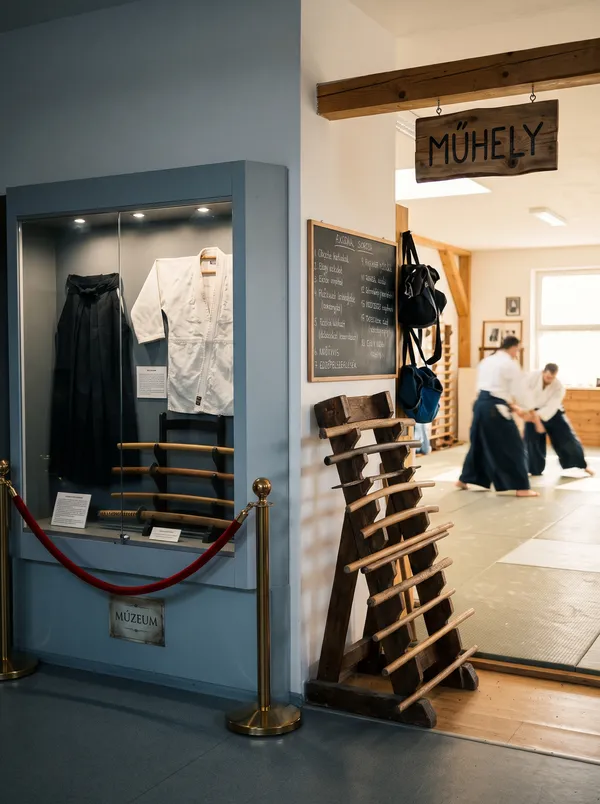
Museum or Workshop? Katadori ikkyo and living aikido
-
12 November 2026. -
Ferenc Németh
When you still step onto the tatami after twenty-five years, you look at movement with very different eyes than you did as a beginner. You are no longer searching for spectacular falls or the outer form, but for the connections: the angles, the distance, the moment the balance breaks. The inner logic that makes a technique truly work.
I often think about what our task is – as practitioners and instructors – with the tradition entrusted to us. In the world of martial arts I see two very different attitudes, and perhaps the best way to describe this duality is the image of the museum and the workshop.
Respecting tradition – and the museum trap
Tradition is fundamental. The historical merit of the centre, the Aikikai Hombu Dojo, is beyond question: it preserved the founder's legacy and created a unified framework thanks to which we can step onto the mat anywhere in the world today and speak a common language. This is the foundation we all build on.
The danger begins when we, the practitioners, start treating this framework as a museum piece. In a museum, objects are locked behind glass: they are beautiful and command respect, but you are not allowed to touch them. If we perform a technique exactly the same way only because "that is how it was shown", and never ask why things happen the way they do, the movement slowly becomes hollow. What emerges is a polite choreography in which the partner already knows at the moment of the grab which way to fall – and practically jumps into the technique.
The best workshop: your own dojo
I do not see it as my job to reform every technique. When I do start rethinking a movement, the reason is always the same: what I used to do did not work for some reason. Over twenty-five years I have collected plenty of such memories.
The best workshop for this work is your own dojo. As I wrote in an earlier article, the hardest job always belongs to the instructor who works with flesh-and-blood beginners. They are not yet trained aikidoka, and they have not learned which way they are "supposed" to fall. If we do not blame them for not falling and getting up on their own, they show us exactly what happens when someone does not behave like a programmed aikido robot.
In such moments the instructor has two choices. One is to train them: to tell the uke that they made a mistake, that they should have fallen, and to show them what is expected. That is the easier path. The other is to try to perform the technique properly, following the principles of aikido. That is much harder. Talking and writing about principles is easy; applying them with a partner who does not help is another matter entirely.
At an international seminar in October I experienced the same thing as uke. Many tori started the technique with a big atemi and a vigorous entry, and from the outside it really did look effective. Sometimes, to make the situation tangible, I did not just hold on but also pushed my partner slightly and stepped towards them, the way a real attacker would. Almost every time, it ended in a collision. From the outside it probably looked as if my uke work was poor. In fact, all that happened was that the attack came a little closer to reality.
It all starts with the attack: what is katadori really?
Before we start dissecting a defensive technique, it is worth taking a step back and examining the attack itself. This is very often where things go wrong: a flawed, unrealistic attack necessarily produces flawed conclusions and unrealistic techniques.
Take the shoulder grab (katadori). Is the attack really that someone walks up to me, grabs the fabric on my shoulder, then stops and waits? In itself, someone taking hold of your shoulder may even be a friendly gesture. Why should that immediately turn into a takedown and a pin? At the same seminar I practised this technique with one of my partners, who stepped in and took hold of my jacket in a completely friendly way. I just smiled. Of course, they did not know what I was thinking – at a seminar the aim is not to teach your partner – but in truth there was no attack, only a friendly grip.
If we are talking about real conflict, katadori is never a finished movement but the beginning of a process. The attacker steps in and grabs not to push me away, but to fix me in place – almost to anchor me – so that they can hit me far more accurately with the other, free hand. The grab is therefore followed almost immediately by a punch with the other hand. It is a situation similar to katadori men'uchi, except that instead of a cut arcing down onto the top of the head, what comes is a fast straight punch or hook from the front.
When physics and geometry ask: what happens in the technique?
If we start from this realistic situation, it immediately becomes clear what happens in the first basic technique, katadori ikkyo, when we only copy the usual outer form. Let us take the case where the partner grabs our left shoulder with their right hand and would punch with their left.
The technique is often performed like this: the defender (tori) enters, delivers an atemi towards the attacker's face with the right hand – the hand on the side that was not grabbed – then moves onto the crook of the gripping arm's elbow and tries to unbalance the attacker by pressing downwards. On paper this looks fine, but if we look at the real geometry and timing, we walk into two serious traps:
- 1. The late atemi, squeezed to the outside: If we enter from the front after the grab and try to deliver the atemi with the right hand, we are simply too late. The attacker's free, punching hand takes the inside, shortest route straight to our nose. Our atemi hand, on the other hand, is pushed to the outside by our own body and the partner's gripping arm. The law of physics is merciless: the attacker's punch will land on our face before our hand reaches its target.
- 2. Pulling the attacker onto ourselves: If we then start pressing the crook of the elbow downwards from the front, the partner's gripping arm works as a lever, since their hand is still on our shoulder. They bend the arm and pull their upper body – head (and punch) included – onto us, without even having to resist. At that point it is the uke who has to be careful not to headbutt tori. A technique cannot be built on the hope that the attacker will look after us.
The workshop's answer: living biomechanics and the power of the body's twist
Later at the same seminar, when it was my partner's turn, I asked whether they felt they were wasting one hand by doing nothing with it – specifically the hand on the shoulder I had grabbed. That hand was simply hanging there, lifeless. Yet that hand could keep the distance, steer the attacker slightly onto the outer arc, and prevent them from turning onto us with the other hand.
When the dojo works as a workshop, the solution is built on the laws of physics and continuous movement:
- Using the hand on the grabbed side: We raise this hand – our left – straight towards the attacker's face. This is the first atemi: it arrives along the inside, short route, so it is not late, and it prevents the partner from turning onto us with the other hand.
- A continuous, circular step back: As the left hand rises, we step back in an arc at the same time: the right foot starts, the left follows. Meanwhile we also take the left hand and the left shoulder backwards. This keeps the partner's gripping hand in front, while their rear hand, ready to punch, gets further and further away and can no longer reach our face. The movement must not stop, because the moment it stops, the attacker immediately regains their balance.
- The arc of the right hand: As the partner starts to drift out, our right hand joins in. This is the second atemi: it starts towards the face, then connects to the partner's right shoulder, slides along the arm to the crook of the elbow and gently tips them there. Meanwhile our left hand must not get trapped next to the gripping arm, so we draw it out. The left shoulder moving back helps with this, since the hand comes along with it.
- The nikyo grip and our own elbow: Our right hand keeps sliding along the partner's arm all the way to the back of their hand, where the grip is. There we take hold of their hand with the grip we know from nikyo and begin to twist it slightly in the direction in which we would otherwise break the grip. Their grip is strong, though; we will not break it, and that is not the aim: it is enough for their elbow to start rising a little. Meanwhile we keep our right hand almost pressed to our chest and do not lift our own elbow. If we did, the partner could push it upwards from below and start an ikkyo-like technique on us – and the defender would easily become the one under attack.
- The power of the body's twist: As soon as the partner's elbow rises, our left forearm fits against it from the outside and pushes the arm upwards. With a twist of the torso and the combined control of both hands, we tip the partner forward. This is not sending them far away: the partner is still holding our jacket, so the unbalancing happens tightly, right in front of us. The power does not come from the arm but from a unified movement that starts from the ground and arises from the twisting of the body. It is the same tight inner rotation we know in qigong as the principle of the twisting root: first a very small twist of the body to the left, during which our left forearm comes up to the elbow, then the body twists back to the right, and this is what tips the partner. This is how different internal movement arts meet and complement each other.
Not a new question: Nishio Sensei's workshop
If we look at the history of aikido, several great masters did exactly this kind of workshop work. One of the best known among them is Shoji Nishio Sensei. He, too, often heard that aikido techniques are closely related to weapons practice and samurai traditions, but nobody could show him how. So he started thinking about it himself.
He was also versed in judo, karate, iaido and jodo, so it mattered to him that what he did should work, at least to some degree. He believed that techniques must hold their ground outside the aikido dojo as well. He did not want to tear down tradition. He examined attacks and defences through the logic of the sword (bokken), the staff (jo) and real combat distance, and refined the angles and the entries.
Nishio Sensei's aikido contains a lot of atemi, yet his system carries a very high ideal. The aim is not only to be able to defend ourselves: we must also take care of the attacker, because we are responsible for them too. That is why his weapons practice is built not on cutting but on control. He called this principle Yurusu Budo.
This is why I chose this path, and it is no coincidence that our dojo bears this name too. I know that what I do does not yet meet this standard in every respect, but all my development is heading in this direction.
The workshop is in our hands
The task of the large international organisations will always be to maintain unity and the framework. Even so, I think it would mean a lot if this workshop approach were visible at the centre as well. The initiative of an individual dojo or instructor gains ground much more slowly than when the leading instructors represent the same thing. As I see it, today we often develop the uke to fit the existing techniques instead: we teach them how to follow the form, rather than examining the form itself. Yet if a technique only works when the uke looks after tori, it is not the uke that needs fixing.
Until then, the workshop is in our hands – in our own classes.
Katadori ikkyo shows this too: the atemi is not a knockout but a way of steering, and the unbalancing is not throwing the partner away but tight, close control. Effectiveness and responsibility for the attacker do not exclude each other; they are two sides of the same well-understood technique.
When we practise on the tatami, it is worth pausing to ask: is the attack I am responding to real? Am I just copying a form, or do I truly understand what my movement causes in my partner's body? If we dare to investigate, the dojo will not become a dusty museum but a living workshop.
This article is also available in Hungarian: Múzeum vagy műhely?
Related articles: What Kuroki Sensei Saw: Six Points for Better Aikido and Ikkyo – the first teaching.