What Kuroki Sensei Saw …and what you hear in every class – six points for better aikido
-
1 October 2026. -
Ferenc Németh
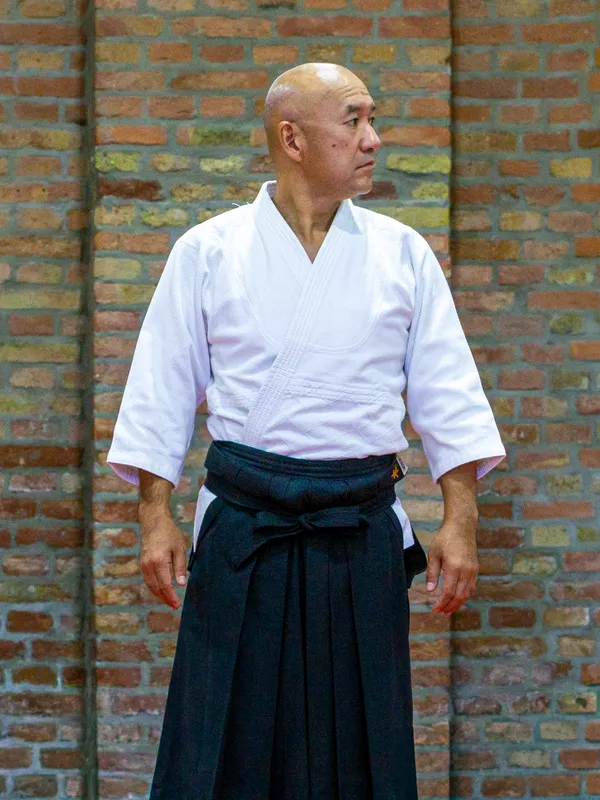
After our seminar in Budapest in September, I asked Takashi Kuroki Sensei (6th dan Aikikai aikido, 5th dan Toho Iaido) for honest feedback on the mistakes he had observed during practice, so that we could learn from them. He sent a short but very precise summary, and kindly agreed that I share it here.
What surprised me was that the list was almost exactly the same as the one I bring up in class week after week. My students recognised it too: the list of mistakes they received from Sensei was the same one they often hear from me.
Why doesn't it work at the seminar when it works in class?
Of course, I understand them. At a seminar like this, everyone is a little nervous – and I admit, so am I. Everyone wants to meet expectations, and it is exactly this desire to perform well that holds us back from our best. In those moments, even the things we discuss and practise every day simply do not come to mind.
That is why an outside eye is so valuable. What Sensei saw shows us the habits that remain even under pressure. What still works when we are nervous has truly become ours; what slips is where our work still lies.
The three most common mistakes
1. Harmony and coordination with uke
In several cases, tori (the person performing the technique) focused too much on completing the technique and moved on without paying enough attention to the condition and movement of uke (the attacker). Tori must constantly observe uke's balance, posture, direction of movement and reactions, and adjust their own movement accordingly.
As Sensei put it, the basic principle is worth reviewing: the goal is not simply to "apply a technique", but to allow the technique to develop naturally according to uke's condition and movement.
2. Ma-ai, hand position and angles
In techniques from ryote-dori, cross-hand grab, morote-dori and kata-dori men-uchi, the distance between tori and uke, as well as the position and angle of the hands, was often unclear. Especially in shiho nage and kote gaeshi from ryote-dori, we tended to blur the gripping position, the hand position, the direction of the cutting movement and the connection of the hands with the body.
Simply reproducing the form of the technique is not enough. We need to understand the exact position, angle, direction and distance of each movement, and how these connect naturally with the movement of the whole body.
3. The line of attack: ken tai ken and ken tai jo
In the weapons exercises, uke's attack line and attacking position sometimes did not pass correctly through tori's appropriate position. As a result, tori had to move forward more than necessary to compensate for uke's incorrect attacking position.
In ken tai ken and ken tai jo, uke's correct attack line, distance and timing are essential for tori to establish the correct position and movement. Therefore we need to check and correct not only tori's technique, but also the way uke attacks. I also wrote about this in connection with irimi: if the attack is not real and does not arrive at the right depth, tori is forced to "enter" on their own, and this is where the false habit is born (The Illusion of Irimi).
Six points for the coming months
Based on what he saw, Sensei suggested the following points for our future practice:
- Tori should observe uke's condition and reactions while moving.
- The correct ma-ai should be clearly established.
- The hand position, angle, gripping position and direction of the cutting movement should be clear.
- The hands should not work independently; they should be connected with the center, the legs and the hips.
- Uke should perform a correct and clear attack, allowing tori to establish the appropriate position.
- We should understand not only the form of the technique, but also the position, distance, direction and timing that make it work.
What next?
These points will be the focus of training in all our dojos in the coming months. They are not new rules, but fundamentals we have to return to again and again – and this time we saw them confirmed through a master's eyes.
Mistakes are not failures; they are the next steps on the path. Thank you, Kuroki Sensei, for your honest and generous feedback, and thank you to everyone who practised with us.
This article is also available in Hungarian: Amit Kuroki mester látott