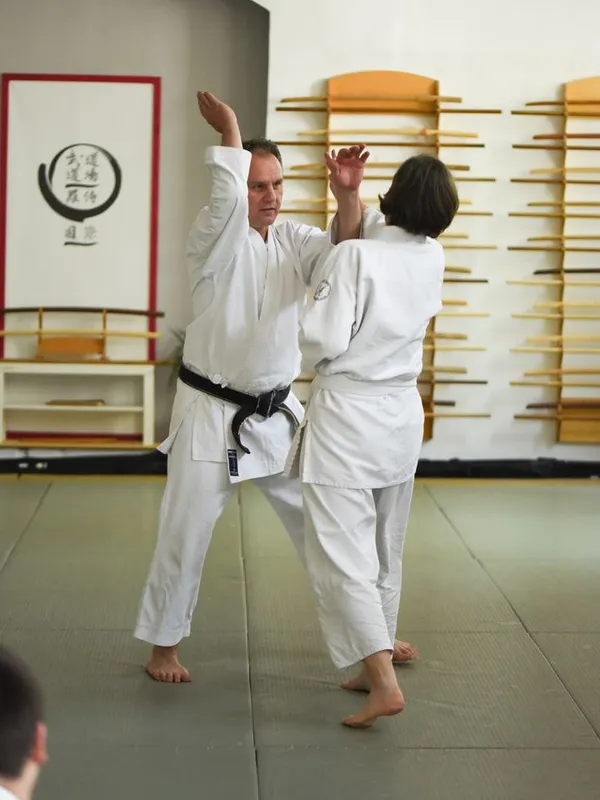
Where did Atemi go? The pacification of Aikido and the loss of martial effectiveness
-
26 August 2026. -
Ferenc Németh
If you walk into an average aikido dojo today, you will likely see softly flowing movements, peaceful harmony, and spectacularly flying, cooperative partners. In mainstream martial arts circles—and internet comment sections—aikido is now widely regarded as a near-zero value, "dysfunctional" system. But was it always like this?
For us who practice Nishio-style aikido, the answer is clear: no. According to one of O-Sensei's (Morihei Ueshiba) most famous sayings, in a real fight, aikido is "70 percent atemi (striking) and 30 percent nage (throwing)". How did we get from ruthless battlefield survival to the hombu dojo almost entirely banishing atemi, sending the art down a slippery slope? Let's look at the historical, biomechanical, and sociological reasons.
1. The historical context and Hombu's paradigm shift
The original form of aikido is inseparable from the martial realities of Japanese feudalism. O-Sensei had a serious background in jujutsu, judo, and swordsmanship, but the technical backbone of the system was provided by Sokaku Takeda and the ruthless Daito-ryu Aiki-jujutsu. Pre-war aikido (Aiki-Budo) was an uncompromising system where the goal was the immediate neutralization of the opponent.
Back then, defense was never passive. Ueshiba's 1938 manual, Budo, makes it clear: in the event of an incoming strike, one must immediately step forward (irimi) and deliver a devastating blow to the opponent's face. It wasn't by chance that the Kobukan Dojo was called the "Hell Dojo" (Jigoku Dojo).
How did this turn into world peace? The answer lies in history:
- 1942 (Retreat to Iwama): At the height of the war, O-Sensei retreats to the countryside, names his estate "Aiki En" (Aiki Farm), and dedicates his time to agriculture and shinto rituals (Omoto-kyo), distancing himself from militarism.
- Post-1945 (The GHQ Ban): The Allied Forces ban martial arts in Japan, viewing them as part of ultranationalism and aggression. Aikido had to change radically to survive.
- 1950s (The Paradigm Shift): Kisshomaru Ueshiba (O-Sensei's son) realizes that bone-breaking Aiki-Budo is unsellable in pacifist, post-war Japan. He begins to dull the martial edges and minimizes the role of atemi.
Kisshomaru Ueshiba positioned aikido as a pacifist form of "true Budo". He censored his father's esoteric shinto teachings, banned competition (randori), and placed the focus on protecting the uke (attacker). Thus emerged the aesthetic, modern Aikikai aikido, stripped of its martial validity.
The irony of selective tradition: Suwari waza vs. Atemi
There is, however, a massive contradiction here that perfectly highlights the anomalies of the Hombu Dojo's modernization. Atemi and weapons techniques were banished under the excuse that they were too "rough" and outdated for modern society. At the same time, suwari waza (kneeling techniques) were kept in practice, and even made mandatory.
In feudal Japan, within the castle of a samurai lord, where seiza (kneeling) was mandatory and defending against concealed weapons was necessary, this had its justification. But today? Its martial, self-defense value in modern combat is absolutely zero. Undoubtedly, knee-walking (shikko) is great for strengthening the hips, legs, and core muscles, but it has no practical applicability. It is highly ironic that aikido clings tooth and nail to a historical element that today only serves a physical conditioning role, while it cut atemi and weapons out of the system—the two things that would provide the true martial essence of the art.
| Dimension | Pre-War Aiki-Budo (O-Sensei) | Post-War Aikikai (Kisshomaru Ueshiba) |
|---|---|---|
| Technical Focus | Survival, joint-destruction, dominance. | Health, flow, protecting the opponent. |
| Atemi (Strikes) | Mandatory, 70% of technique; devastating power. | Banned, minimized, or purely symbolic. |
| Testing | Hardcore resistance, dojo challenges. | Cooperative practice, resistance is forbidden. |
2. What does Atemi actually mean?
Before we move on to physical shortcomings, it is very important to clear up a fundamental misunderstanding that causes many to reject atemi as "too violent."
Atemi does not necessarily mean a knockout (K.O.). It is not a raw, stiff punch that completely breaks the movement's direction or the flow of the technique. Atemi is primarily an action designed to break the opponent's intent and attention.
A well-timed atemi "hijacks" the attacker's brain: for a fraction of a second, they forget their own attack because their nervous system focuses on the incoming danger. This tactical depth is illuminated even better if we examine the three main types of atemi:
- Visible (provocative) atemis: These intentionally arrive from a direction the uke can clearly see. Their goal is to trigger a plannable, predictable defense mechanism. With such a strike, for example, you can perfectly provoke a grab or a block, making the attacker voluntarily "give" their hand for the technique.
- Hidden (invisible) atemis: These come from the blind spot, from an unexpected angle. Because they are hidden, you cannot prepare for them, causing a massive surprise. Their role is primarily to immediately change the direction of the attacker's movement and original intent, completely knocking them out of their own rhythm.
- Non-contact (virtual) atemis: In fact, a portion of atemis doesn't even need to physically reach the uke. The mere fact that the tori's body movement—the initiation of the kinetic chain preceding the strike—reveals the intent is enough for the uke to react, as they immediately notice the threat.
Just how universal this martial arts principle is was well demonstrated in an old Bruce Lee exhibition match. Lee launched a high side kick to the head, but his partner simultaneously initiated a straight kick. As their body positions mutually revealed this intent, Lee read the other's action from a fraction of the movement, immediately retreated, and changed tactics. In aikido, a well-applied atemi exploits exactly this cognitive reaction. Of course, it's important to add that this kind of intent-reading and reflex-regulation without physical contact can only be expected from highly advanced practitioners.
Atemi as a pedagogical and biomechanical tool
Atemi is not just a martial technique, but a process from which both parties learn.
From the tori's (defender's) side: The one delivering the atemi learns distance (ma-ai) through it—they must feel exactly where the uke is. If you observe, most atemis dealt out in today's trainings are just weak waves that stop a good 30-40 centimeters before the uke. But that's only half the problem. The other half is that the movement completely lacks intent, which in itself would be enough to break attention. Furthermore, biomechanically, for most atemis, the arc of the hands perfectly matches the direction of the body's twist (rotation), so the two brutally reinforce each other. This structural power transfer is entirely missing from a distant, disconnected wave of the hand.
From the uke's (attacker's) side: Atemi teaches them to take reality into account. It prepares their body and mind: if a strike is coming toward you, you must instinctively react to it. If you don't prepare for this in training, if there is never any real pressure, you are guaranteed not to be able to react in a live situation.
Do a test at your next training: stand facing each other, and try to touch your partner's nose with the back of your hand. First, do it so the other person cannot pull their head away. Count it: how many times do you reach it perfectly with a gentle touch, and how many times do you accidentally smack them in the nose? 😀 This exercise ruthlessly shows how much you (don't) sense real distance.
Then comes the second phase: your partner can pull their head away as soon as they sense the hand moving toward them. This playful but serious test immediately highlights everyone's distance perception and reflexes—and exactly this capability is what real atemi should develop.
3. Biomechanical distortions: The paradox of Kuzushi and continuous unbalancing
The foundation of Japanese throwing techniques (nage-waza) is kuzushi—breaking the opponent's balance. In judo, this is achieved with physical strength, gripping, and weight shifting. The promise of aikido, however, is that we unbalance the attacker purely by redirecting movement vectors.
Here comes the paradox: How do you unbalance someone whose absolute intent is to immediately regain their balance and continue the attack?
After all, in a fight, the opponent doesn't just strike a stable, rigid statue pose. The uke's fundamental task—with genuine intent—is to continuously correct their position, regain their stance, and attack.
It is easy to see that one of the main and indispensable characteristics of aikido techniques must be the uke's almost continuous state of being unbalanced. A technique cannot be executed if the attacker smoothly regains their stability and the initiative. However, this continuous control—against a genuinely aggressive opponent—is almost impossible to achieve without atemi.
When a strike is launched toward the attacker's face, it triggers the startle reflex. The opponent throws their hands up, tenses, their center of gravity rises, and their joints "freeze." Kuzushi is created in this fraction of a second, and the continuous threat of atemi maintains this stiffened, vulnerable state until the end of the technique.
The degradation of Ma-ai and the "Compliant Uke"
The lack of atemi started a domino effect:
- Ma-ai (martial distance) was lost: Since the uke isn't threatened by a real strike, distances and entry angles (irimi) loosened up. Instead of an aggressive step into the "blind spot", passive, wide evasions developed, which in a real situation would result in an immediate counterattack.
- The "Compliant Uke" syndrome developed: Originally, ukemi (falling) was an emergency survival mechanism to escape a bone-breaking lock or an atemi. Today, students are conditioned to attack with unrealistic momentum, not pull their hands back, and perform a somersault at the slightest touch. This creates false feedback (cognitive dissonance): practitioners believe they are controlling lethal energies, when in reality they are performing an agreed-upon moving meditation.
4. The lack of "Aliveness" and false confidence
In modern martial arts theory, there is a very important concept: "Aliveness". A training method only prepares you for reality if it contains three indispensable ingredients: unpredictable timing, dynamic free movement, and real physical resistance.
Unfortunately, mainstream aikido pedagogy very often fails this test. In training, the attack and its timing are pre-arranged; the uke rarely exerts real force and intent aimed at stopping the technique; and movements start from static positions. It doesn't matter if aikidokas execute their techniques fast and spectacularly at demonstrations, if the attack is choreographed and lacks pressure behind it, it will not prepare the central nervous system for the suddenness of a conflict.
Due to the lack of the threat of atemi and true attacking intent, mainstream training methodology creates a sort of closed bubble. It gives practitioners false confidence, making them believe that fine motor movements mastered in a harmonious, cooperative environment (like an empty-handed wrist lock) will work against an aggressive opponent consciously trying to regain their balance.
What about the children?
Experiencing "aliveness" and resistance is crucial even in childhood. In our children's classes, for example, there are many "competitive" games. This, of course, doesn't mean we treat aikido itself purely as a competition, but simply that at this age, a little healthy competition doesn't hurt at all; in fact, it is highly motivating. They need these playful but still real, resistance-based situations to feel the dynamics and experience what actually works when the other party doesn't give in easily.
5. Those who preserved Budo: Weapons and Atemi
Fortunately, not everyone followed Aikikai's path of pacification. Several of O-Sensei's senior students recognized that abandoning atemi and the weapons foundation is equal to biomechanical suicide.
Nishio Ryu (Shoji Nishio)
For us, the most important example is Nishio-style aikido. Shoji Nishio came with a hardcore judo, karate,
jodo, and iaido background, and was disillusioned by Hombu's modernized, atemi-free system. He created the
perfect fusion of weapons and atemi.
- Atemi as the soul of Budo: The rhythm of the techniques is provided by atemis simulating sword strikes. Their goal is precisely the aforementioned nervous system neutralization, the cutting of intent.
- Tsukuri, Kuzushi, Kake: Modeled after judo, he incorporated the Tsukuri (trap setting) phase. At the moment of contact, atemi and continuous unbalancing are already present.
- Aiki Toho Iai: His own sword-drawing system is not a separate element, but a direct reflection of aikido's empty-handed techniques (riai – unity of principles). The geometry of the sword cut and the atemi are identical.
Iwama Ryu (Morihiro Saito) and Yoshinkan (Gozo Shioda)
Master Saito preserved the more pragmatic, rural line in Iwama, where exercises starting from rock-hard,
static grips and weapons forms (bukiwaza) were mandatory, complemented by kicks and joint-destroying
potential (Ara-Waza). Gozo Shioda's Yoshinkan system conserved the pre-war Aiki-Budo phase: strict geometry,
focused exertion of power, and the ruthless subjugation of the opponent (it didn't become the system of the
Tokyo riot police by accident).
Shodokan (Tomiki Aikido) – the refreshing exception
Although it divided aikido society for a long time, Kenji Tomiki's system chose a very brave and clear path
to preserve feedback: he introduced shiai and competitive randori. In the Tomiki line, fighting against a
live, uncooperative partner constantly tests timing, distance, and the functionality of techniques. Although
the application of atemi is naturally more restricted due to competition rules, because of its practical
realism and continuous testing, Shodokan absolutely has its place among the styles that preserve martial
values.
| Lineage | Role of Atemi | Integration of Weapons | Practical Realism |
|---|---|---|---|
| Nishio Ryu | Absolutely central, breaker of intent. | Maximum fusion (Aiki Toho Iai). | Immediate trap-setting, active irimi. |
| Iwama Ryu | Strongly present for kuzushi. | Equal status (riai), mandatory bukiwaza. | Static, full-resistance kihon. |
| Yoshinkan | Solidly present. | Less central, focus on taijutsu. | Military strictness, strong pins. |
| Shodokan (Tomiki) | Important for kuzushi, but limited due to competition. | Present (mostly tantō randori, basic ken exercises). | Very high (live resistance randori, shiai). |
| Aikikai (Hombu) | Neglected, condemned, symbolic. | Secondary, often absent. | Compliant uke, aesthetic flow. |
The peaceful, global expansion of mainstream aikido came with technical and biomechanical sacrifices. With the loss of intent-breaking atemi and real entry distances, the system often loses its martial aliveness. At the same time, the systems laid down by Nishio, Saito, Shioda, and Tomiki prove to this day: if aikido preserves atemi, weapons principles, continuous unbalancing, and is able to test its techniques under live pressure, it truly remains a functional, pragmatic, and respectable Budo. We simply must not forget that certain 70 percent.