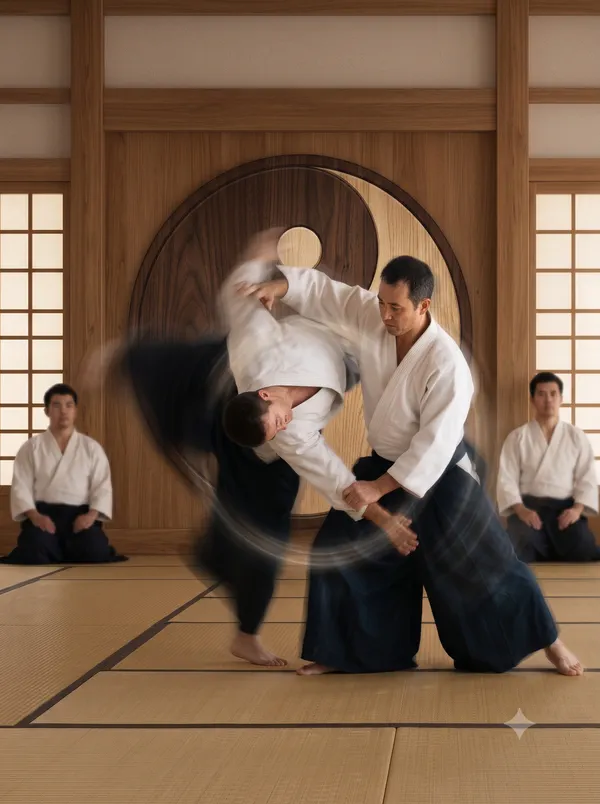
The True Role of the Uke Just "grunt work" or do they teach the master?
-
12 August 2026. -
Ferenc Németh
To be honest, looking back at my beginner years: I didn't like being uke (the attacking, falling partner) at all. Back then, I felt it was just some sort of "grunt work." Something to get over with quickly, to endure, so that I could finally be the tori (the defender) and execute the technique.
In the dojo, almost everyone prepares to be tori. Often years, even decades pass with the teaching focus almost exclusively on the tori's work, while the attack is dismissed with a simple "Uke, attack!" command. Yet a practitioner who hasn't encountered any other martial art before likely has no real concept of what an honest attack actually means. They've only seen their peers and try to imitate something similar.
The trap of the safety net: Why the "ballet" doesn't work?
The role of the uke (or attacker), of course, doesn't only exist in aikido. However, if we look at a karate practitioner, a bad attack, a false distance, or being off-rhythm is immediately revealed. There, the uke cannot do foolish things, because physical reality—in the form of a slap or a kick—provides immediate, painful feedback.
In aikido, on the other hand, since the goal is precisely to avoid permanent injuries and joint destruction, there is an artificial safety net. This net is of immense value, but also the biggest trap: it allows a bad uke to "survive" inauthentic, weak, or half-hearted attacks as well. If the focus isn't there, practice can easily degrade into clowning around, a sort of "shared ballet."
In demonstrations, we often only see the grandmaster executing beautiful, devastatingly powerful techniques, while we know nothing about the "nameless" ukes. Seemingly, the uke always plays a subordinate role. But...
The two extremes of the spectrum and the definition of the uke
The reality is that the uke is the one with whom the master can demonstrate what they want at a high level. If those nameless ukes didn't possess incredible body awareness, the master's technique wouldn't be able to prevail either. At the same time, the uke is also the one who can ruin everything with a single false move, making the whole system look ridiculous.
If we wanted to define exactly what the uke's true task is, we should formulate it something like this:
"The uke creates the specific situation most suitable for learning or executing a technique, and is able to process the technical elements used within it (by the tori) well and without injury."
Or as Mitsugi Saotome writes—which you can also read on the AIKIDO TENJINCHI DOJO page—the uke is the one who, through active communication and high-level perception, creates the conditions for the tori's development. They are the raw material, the reality checker, and the partner without whom the technique remains merely an illusion.
The path of shared development
It's important to clarify: both parties learn from an honest attack. It's a two-way process. The tori gets the environment and realistic situation necessary to polish their technique. Simultaneously, the uke develops as well: they learn to accurately manage distance (maai), become capable of safely reaching the tori, and then, during the technique, they learn to process and "survive" the energy returned by the tori.
This is how uke-work becomes the dojo's most important, shared pedagogical tool.
What does an "honest" attack actually mean?
Before anyone misunderstands, it's important to clarify what we mean by an honest or good attack. Many people think it means uncontrolled street aggression, where the uke rushes at the tori in a frenzy, screaming their lungs out, wanting to tear them apart.
The reality is that this kind of blind aggression would be far too simple. A good attack is orders of magnitude more refined. The goal is not simple and immediate destruction. If an advanced uke immediately "tramples right over" a beginner with full force, they teach them nothing, only cause frustration, and the practice loses its pedagogical value.
The one who sets the bar: The uke as a teacher
An honest attack is actually a continuously calibrated, intelligent transfer of energy. The uke's task is to constantly monitor the tori's level, and as the defending party improves, gradually raise the bar. The distance gets more precise, the speed increases, the structure and pressure become more massive.
And from this fine-tuning, a clear fact follows: since the uke manages the bar, they cannot be less skilled than the tori. Only a highly trained practitioner is capable of delivering an attack with exactly the right level, force, and direction that challenges the tori, yet remains just manageable for them.
Atemi as communication and masterful sensitivity
Nothing proves how refined a task it is to be a good uke better than the proper reaction to an atemi (strike). Master Christian Tissier explained the true role of atemis exceptionally clearly at one of his seminars.
Many think that the atemi serves purely for destruction. In reality, it is a firm signal, physical communication: "You need to change your attack." This can mean having to give up the position or pull the head away, because if the uke keeps forcing the original direction, they will get hit.
A masterful uke rarely receives an actual strike. Not because everything is pre-arranged, but because they read the tori's body language. They watch the eyes, sense the micro-movements of the hands. Even before that hand strikes down, the uke already knows exactly: "If I continue this here, I will get hit – so I must change." This live reaction creates the flowing dynamics seen in the techniques.
The birth of the attack: Gaze and intent
The attack must be born the very moment the two practitioners stand facing each other and their eyes meet. If the tori only meets a blank stare, that is not enough.
We often see at large demonstrations that the uke hasn't even fully gotten up from a fall, yet they are already stumbling towards the tori. This gives a false picture. It seems like it leaves the tori no time, but what they are doing isn't an attack, just a blurred mess.
A true attack must always be deliberate and measured. Think of a classic samurai movie: how the warriors look at each other before doing anything. The movement should have a very specific, firm starting point.
Closing the distance: Stalking, not a mindless rush
Closing the distance (maai) is a critical phase. Whether the attack is a grab or a strike, the uke cannot launch into a mindless crusade. Their movement must be a stalk with a very precisely measured tactic. While approaching, they must not open their own structure: they shouldn't raise their hands unreasonably high, nor stick them out in a way that gives the tori an open target surface.
Many make the mistake of stopping as soon as they reach the tori. The attack does not end upon reaching the tori; that's when it begins. In this movement, the uke cannot lose their target for a single moment. The tori must feel: "I have to do something, but a single step away won't be enough, because the uke is right on my heels."
The trap of "stopping": When the attacker becomes an assistant
Unfortunately, 99% of the time, you see that as soon as the uke reaches the tori, their momentum stops, and they start pivoting on one leg, balancing. This is pure habit; they think they are "learning aikido," so this is what is expected of them.
I think differently about this! The uke must continue to maintain the pressure. The tori has to come up with something to unbalance this striving uke from their position—the uke isn't going to do it on their own.
If the unbalancing begins, the uke must be careful not to end up in a completely vulnerable position (for example, they shouldn't turn their back to the tori). If we were to step outside the dojo environment, such a position would mean certain doom for the uke.
And here comes the most important part: if the uke does end up in such a clumsy, bad position, the tori shouldn't force the original technique upon them. They should abandon the pre-planned form and simply take advantage of the new situation the uke created with their mistake.
The moment of decision and the turning of Yin-Yang
During the execution of the technique, the uke can receive an atemi (or a signal that a strike is coming) at multiple points. They have two choices: either they heed the signal and consciously react to it, or they take the hit and will be surprised. Whichever they choose, their attack will change.
In reality, throughout the technique, the two parties map out the eternal play of Yin and Yang. When attacking, the uke is strong (Yang), and the tori is weak and receptive (Yin). As the technique progresses, this relationship seamlessly flips: the tori becomes strong and takes control, while the uke becomes weak and vulnerable.
In this final situation, throwing or rolling is child's play. We often see practitioners focus exclusively on this very end of the process. This is a huge mistake! Without an honest, good beginning, that real opportunity for the finish will never arise.
Look beneath the waves: The depths of the ocean
Putting such a complex, moment-to-moment dialogue into words is not easy in the slightest. Still, this description might be easier to reread and interpret than watching a spectacular technique. The big throws and acrobatic movements of famous masters easily distract our attention from the essence.
It's important that we don't just admire the rippling waves on top of the ocean—we must also see into its depths.
If something isn't right in the technique, it's not necessarily the tori's fault. If the attack is incorrect to begin with, it teaches the tori something other than what it should.
I encourage you to do the following: Next time you watch an aikido video, don't let your attention be captured by the master's rank or name! Just pay attention to what the uke is doing. What is happening to them? Are they waiting in a stable position before the technique?
If so, close the video and find a better one!