The Illusion of Irimi Why entering is not (just) stepping forward
-
23 September 2026. -
Ferenc Németh
At Kuroki Sensei's seminar in Budapest on 19–20 September, we had the chance to discuss a fascinating topic that blew a few fuses for many people, or at least led to some serious head-scratching. Sensei repeatedly used the term irimi even when he was clearly stepping backwards. How can "entering" go backwards? – several people asked. To understand this, we need to dig a little beneath the geometry of traditional Japanese martial arts and aikido.
When we start aikido, we all learn that irimi is a decisive step diagonally forward, towards the attacker. Pedagogically this is brilliant: it teaches us not to retreat instinctively, to close the distance and to overcome our fear of physical contact. What is more, in the yin-yang logic of aikido, tenkan represents the receptive, turning yin, while irimi represents the penetrating, active yang energy. But as we progress along the path, this linear way of thinking at some point becomes a conceptual obstacle. When a sword cut is coming, pure geometry is a deadly trap.
The quality of the attack and the trap of the "passive uke"
One of the main reasons why irimi becomes fixed in our minds as a simple step forward is the quality of the attack itself (the role of the uke) during practice. If we look closely, the uke plays a critical role in making the attack arrive at the right depth.
If the uke is hesitant, simply stops and "places" their hand like a static target waiting to be hit, the distance does not close by itself. The tori (defender) then feels forced to cover that distance and to "enter" straight in. This dead dynamic is what creates the false habit.
A real, sincere attack is not like that. It is powerful, overwhelming and penetrating. If someone simply steps frontally into such an uncompromising attack, following the rules of geometry, they will be knocked over like a bowling pin at that very moment. It is the energy and momentum of a real attack that allow irimi to be not a desperate, distance-closing rush, but an intelligent taking of position.
The legacy of the samurai: the true purpose of entering the body
Irimi (入り身) literally means entering (iri) the body (mi). The concept dates back long before O-Sensei's era, to the sword and spear fencing of koryu bujutsu (the old schools) and to Daito-ryu jujutsu. In the old schools (such as Yagyu Shinkage-ryu), irimi denoted not a direction but a state: breaking through the opponent's defence and occupying the position where they are already helpless, while our weapon dominates.
Its soul is riai (理合), the tactical and mechanical logic behind a technique, which balances distance (maai), timing and posture. If the distance is wrong, irimi is not a brilliant technique but suicide.
Why is staying on the line fatal?
The weapons we use in everyday training – the bokken, the jo and the iaito – build exactly this spatial awareness in us. When we work with weapons (aiki-ken, aiki-jo), it immediately becomes clear that staying on the line of attack (seichusen) is hopeless. Saito Morihiro Shihan always emphasised that the very first movement of the foot must take us off the direct line of attack. When the opponent cuts, their blade creates a deadly geometric plane; our body has to leave this plane while our energy penetrates into their open zone.
Ellis Amdur, the respected martial arts researcher, puts this brilliantly. In his view, purely reactive counterattacks (when we merely evade and then strike back) end up commemorated in the graveyard. The essence of irimi is to take over the attacker's space. As Amdur puts it, "two objects cannot occupy the same space" – and the one with greater power, speed, timing and postural stability takes that space (Ellis Amdur: Irimi, Aikido Journal).
It is worth knowing that Amdur writes this about Itto-ryu swordsmanship, where the cut is made on the very same line. Taking the space, then, does not always mean leaving the line: sometimes it means being the stronger one on it. What is fatal is staying passively in the path of the attack.
The magic of the dead zone (shikaku): a U-turn into a parking space
So where do we enter, if not necessarily diagonally forward? The answer is shikaku, the attacker's dead zone or blind spot. This is the zone (usually behind the line of the shoulders) from which the attacker can no longer generate power and where the range of motion of their limbs is restricted. Once we have arrived there (while also controlling their balance – kuzushi), we have performed a tactically successful irimi.
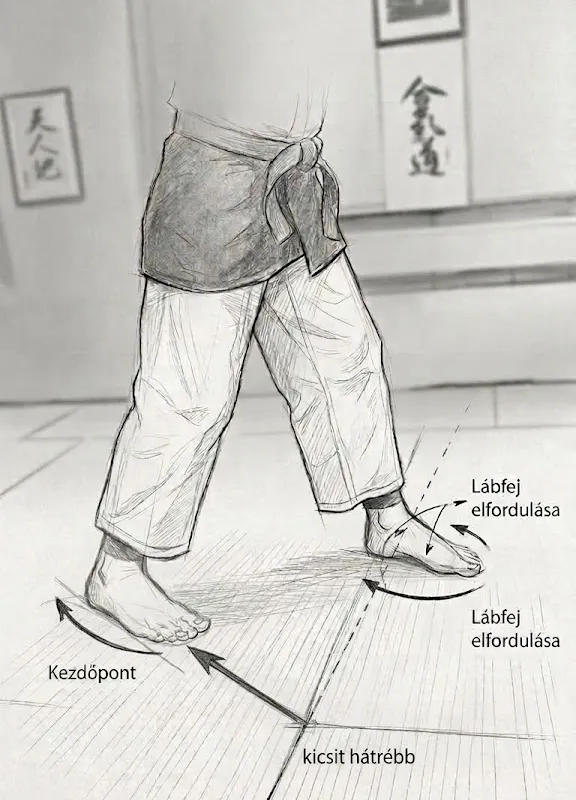
And here comes the apparent paradox that Sensei also mentioned! We often reach this dead zone most effectively by stepping backwards or to the side (tenshin, hiraki) to keep the right distance (maai), or perhaps by turning with a tenkan.
A reader's comment under Amdur's article offers a great example – street parking: if you spot an empty space on the other side of the road, you pull in with a sudden U-turn. Physically you may have turned around (tenkan), but in terms of the goal it is a rock-solid entry (irimi) into free space!
Experiencing such an entry as uke is quite startling. A poor, purely forward irimi often leads to a physical collision. A good, tactical irimi, however, does not hurt the uke: it feels much more like reaching for a stair in the dark that turns out to be one step lower than expected. Suddenly the space runs out, the target disappears, and the momentum falls into emptiness.
The masters and their approaches to irimi
If we look at the great masters, we can see that all of them went beyond the fixation on direction:
- O-Sensei: In his later years he embodied spontaneous, spherical movement (Takemusu aiki). In irimi nage he often gripped the uke's collar firmly and drew the attacker in to himself, reducing the distance to zero and instantly collapsing their structure.
- Shioda Gozo (Yoshinkan): He was immensely dynamic. With stiff arms pointing downwards he entered (irimi) like a wedge, and the attacker literally bounced off him.
- Nishio Shoji: For those of us who also practise in the spirit of Yurusu Budo, his approach is especially important. Nishio Sensei rejected excessive stepping forward, because it breaks the connection (musubi). Instead, he taught a half-step irimi (at about 30 degrees) starting from the natural stance (shizentai). This took him straight into the dead zone (shikaku), prepared the loss of balance (kuzushi), and he controlled the situation with a decisive atemi that, in the spirit of forgiveness (yurusu), was directing rather than destructive.
Atemi and sokumen: controlling the space
This can be seen even in sokumen irimi nage or kokyu ho. When working on the sokumen (the side surface), we often draw out the attacker's spine by lowering our centre of gravity or with a subtle step back. There is no frontal step forward, yet the result is pure irimi.
The strike (atemi) is not there to cause pain either. Nishio Sensei's system uses it to interrupt the attacker's intention. When we enter, the atemi physically occupies the geometric space the attacker wanted to use.
Irimi, then, is not an arrow shot straight ahead. Irimi is a tactical state. It is the unquestionable command of space, distance and timing (maai), and it is impossible to understand without a sincere, deeply penetrating attack.
The next time you stand on the tatami and your partner launches an attack, first check: are they really attacking? Do they actually reach you, or do they just stand there waiting? If the attack is real, don't just focus on which way you step. Find their dead zone, take their balance, let their momentum fall into nothing, and take their space – regardless of whether your feet are moving forward, sideways or backwards.
After the seminar, Kuroki Sensei also summarised in writing the mistakes he had observed, including the problem of uke's line of attack: What Kuroki Sensei Saw.
This article was originally published in Hungarian: Az Irimi illúziója