How to Keep Beginners on the Tatami? Overcoming Fears, True Motivation, and Supportive Teaching in Modern Martial Arts
-
June 4, 2026 -
Ferenc Németh
Author's note: This article is primarily a professional piece for Aikido instructors, dojo leaders, and advanced practitioners. Its goal is to provide practical ideas, pedagogical methods, and research data to help colleagues facing similar challenges in reaching and retaining beginners in today's changed market. Naturally, it can also be read by laymen—giving you a glimpse behind the scenes of the dojo—but the language and focus of the article approach the topic from the instructor's perspective.
(Continued: Where Have the Beginners and One-Week Training Camps Gone?)
In our previous article, we explored in detail how the demographics of martial arts seminars have transformed, and why high-ranking, senior practitioners have become predominant through the "inverted pyramid" phenomenon. The question that preoccupies us all: how can we reverse this pyramid? How can we make the dojo attractive to beginners again in a world where people could spend their time on a thousand other things?
Recent sports market data clearly point out that traditional martial arts are currently struggling with the "Kodak effect": the knowledge and values are excellent, but society's needs have drastically changed. Modern people, fleeing from stress and performance pressure, are no longer looking for raw dominance on the tatami. Experience and behavioral psychology research also show that it is no longer difficult to "acquire" people, but to retain them. This retention power rests on two pillars: communication that consciously breaks down psychological barriers and empathetic pedagogy.
Let's look at the building blocks that characterize a modern, adult-friendly martial arts community!
1. The Digital Tatami and the Strategy of "Niche" Marketing
Many people think that the struggle for beginners today requires aggressive marketing and loud advertisements. Frankly, sometimes I would prefer to "hide" the existence of my dojo, based on the principle that those who are seriously interested will research and find the path meant for them without billboards.
Industry data confirm this intuition: mass marketing ("spray-and-pray") is counterproductive for martial arts. The true power of Aikido lies in niche marketing. It is vital to produce writings that do not promote combativeness or "destroying the opponent"—these create false expectations—but react to the real problems of a broader audience. We do not bombard people with unsolicited newsletters, but we educate: we present the stress-neutralizing and posture-improving effects of our movements. The goal is for those searching for terms like "joint-protecting movement" or "mental focus" to get a clear picture of us and become committed students with a high Lifetime Value.
2. Dispelling Myths and a "Secret" Trick: The Open Warm-up
A significant portion of adult prospects struggle with a huge invisible obstacle: kinesiophobia (the psychological fear of injury). Misconceptions live in them; many believe that Aikido is some aggressive, "brawling" activity for which they are already too stiff.
This cognitive barrier is almost impossible to break through with words. However, there is an excellent method to lower the threshold: the open warm-up. Opening up the thorough, joint-protecting pre-training mobilization—which is closely related to the health-preserving principles of Qigong—to outsiders is a bullseye. It does not mean extra work for the instructor, but its effect is dramatic. Those struggling with kinesiophobia (especially those over 45) enter the dojo through a low-risk "gateway" movement form. At the end of the class, they can see the actual Aikido training up close and convince themselves with their own eyes that there is no brawling involved, only a safe, cooperative practice. Their fears vanish.
3. Differentiated Instruction and Resolving Ego Threat
Adult beginners arrive with incredibly diverse backgrounds. Many step onto the tatami with a feeling of physical inadequacy and strong ego threat: they are terrified of looking ridiculous or falling behind.
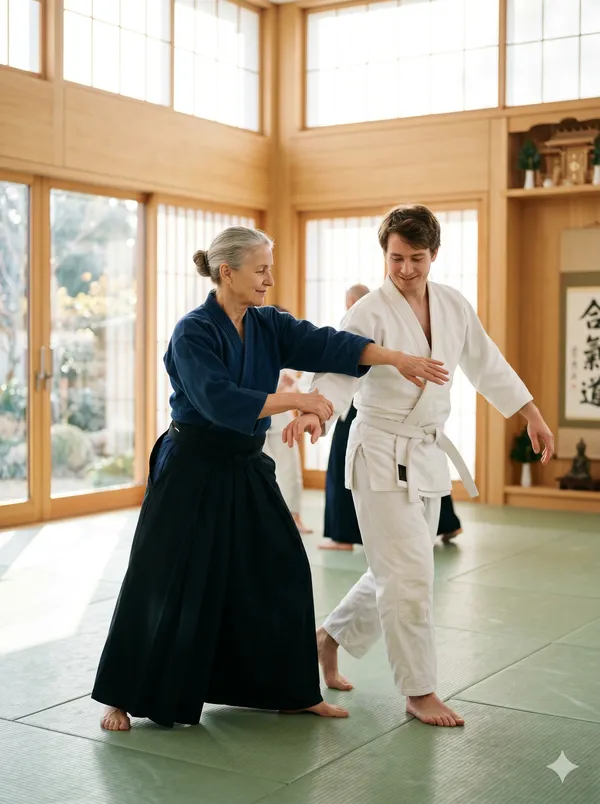
According to sports psychology, modern practitioners are driven by intrinsic motivation, rather than victory over others (extrinsic motivation). The secret of a supportive dojo is that both the natural talent and the beginner struggling with their own limbs receive their own challenge. We motivate the more skilled by refining subtle angles of inclination, while for the more uncertain, the daily victory is simply understanding the directions. If partners are constantly rotating during training, it is the most excellent tool for relieving anxiety. In Aikido pedagogy, a mistake is not a mark of shame, but an indispensable tool for internal fine-tuning.
4. Sense of Security and Overcoming the "Opponent Inside"
One of the greatest challenges for adults coming from civilian life is rebuilding their relationship with the ground. We haven't rolled since childhood; the ground seems hard and distant. When learning ukemi (falling techniques), the beginner faces the "opponent inside"—the instinctive anxiety related to injury.
The best pedagogical approach here is maximum patience and gradualness. This barrier is easiest to dissolve if instruction starts near the ground, from a kneeling position (seiza). This reduces the fear of impact and kinetic energy to almost zero. As the technique becomes safe and trust is built, one can start from higher and higher positions.
5. Applied Biomechanics and the Praise of the Basics
For trained black belts, basic movements are already burned into the spinal cord. At the same time, for 26-45-year-old beginners, who mostly do sedentary work, the basics represent true therapy. For this age group, prolonged sitting leads to the breakdown of sagittal balance and chronic muscle tension.
In a retaining environment, we teach Aikido not only as a martial art, but as applied biomechanics and a postural correction system. Step-by-step, clean basics and the principle of "Keep One Point" do not just teach them a technique, but bring them that neurophysiological flow experience which is the perfect antidote to workplace stress.
6. The Beginning of the Technique: Breaking Balance Instead of Force
One of the most important teachings of traditional budo is that the soul of the technique is not provided by a devastating finish. If the very beginning of the movement—making contact and breaking the partner's balance (kuzushi)—is not perfect, it can only be compensated for later with raw physical strength.
The focus of modern, injury-free practice is exactly kuzushi. If the breaking of balance is brilliant, the throw happens by itself, without painful joint twists. This is the very spirit of Yurusu (forgiveness, acceptance), which bears an uncanny resemblance to the principles of Nonviolent Communication (NVC): instead of dominance, we strive for energy transfer without resistance. The beginner learns: on the tatami, we are partners, not opponents.
7. The Ego Stays Off the Tatami
In the age of digital isolation, both young people and adults crave genuine, offline communities. The most honest gauge of a dojo's quality is what the students talk about in the locker room after training. Where practitioners form a friendly community, people gladly show up even at dawn.
This retaining atmosphere is built from small gestures. From how the advanced students help the beginners. There is no need for excessive mystification: it sends a much stronger message than the formal lineup if the instructor sits at the end of the line, next to the lowest ranks. We start the day recharged, not exhausted.
8. Beyond the Spotlight and the "Rising Tide" Model
Secretly, almost every instructor desires the glamour surrounding grandmasters holding large, international training camps. Many feel this is the peak of the career. But if we put our egos aside: the real, most difficult "fieldwork" is never done in the spotlight.
A grandmaster holds a masterclass for a motivated, prepared audience. They don't have to dissolve the mortal fear of the ground in a beginner arriving from a civilian job. This heroic work is done by local instructors and dojo leaders. They are the ones who build a practitioner from nothing and maintain a community day by day.
It is time to recognize the truth of the "Rising Tide" (a rising tide lifts all boats) model: we local instructors are not competitors with each other. International masters shape the canopy of the tree, but local instructors are the roots, without which the tree would never grow large.
So beginners haven't disappeared. They are out there, looking for communities where intrusive marketing is replaced by conscious education, violence by smart biomechanics, ego by empathy, and rushing by patient teaching. If we create such an atmosphere, the dojo will fill with life on its own.