Where Have the Beginners and One-Week Training Camps Gone? Changes in Training Camp Habits and Their Causes
-
May 28, 2026 -
Ferenc Németh
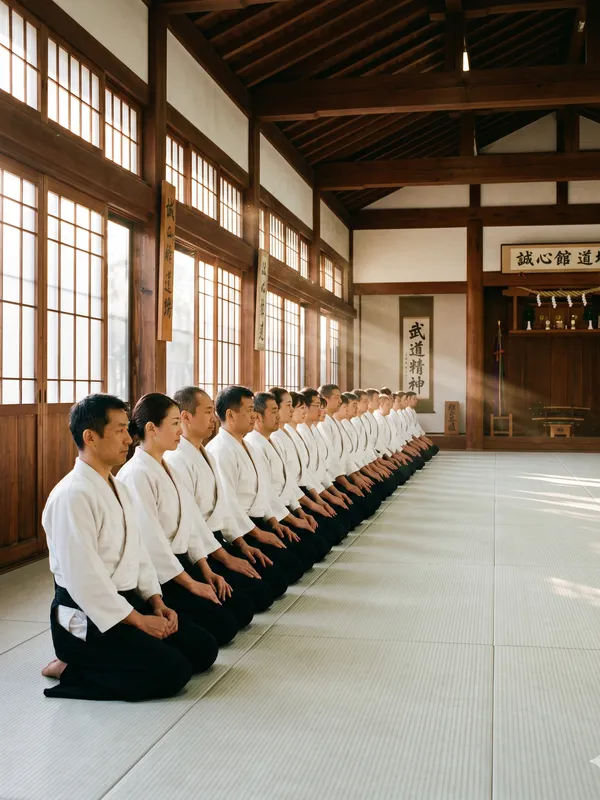
Anyone who has been wearing out the tatami for decades remembers exactly those times when a serious Aikido training camp lasted five days, or even a full week. Seven hours of hardcore practice a day, a massive turnout, hundreds of white belt beginners present, with the black belt core practicing among them. If we look around today, we are witnessing a radical paradigm shift: the era of long camps is slowly fading, replaced by more compact, fast-paced one- or two-day weekend seminars.
But why is this happening? Has enthusiasm simply waned, or are there deeper reasons in the background? To answer this question, it is worth looking beyond the walls of the dojo, towards modern sports physiology and social changes.
Shrinking Space and Shifting Focus
Objective market and search data show that traditional martial arts are fighting for attention in an increasingly shrinking market. The IBIS World market analysis highlights that the growth of the martial arts industry has slowed significantly over the past ten years. In the United States, the number of registered schools dropped drastically in the mid-2010s, and according to Google Trends data, global searches for the term "aikido" have fallen by about 90% since 2004.
The "dying aikido" narrative, however, is an exaggeration. In Japan, 7,500 practitioners stepped onto the tatami at the recent All Japan Aikido Demonstration. The art is alive, but the practitioner base and their rhythm of life have changed. Due to high hall rentals, equipment costs, and the everyday rush, the focus has shifted from long, expensive camps involving travel to shorter, more intensive local seminars. International federations have also adapted and relaxed the mandatory camp hours tied to grading.
The Inverted Pyramid: Where Have the Beginners Gone from the Tatami?
Anyone who was on the mat in the heroic age knows: in a two-hundred-person training camp, the tatami was almost snow-white from the beginners' uniforms, and it was a good sign if three or four black belts (yudansha) moved in the crowd, directing the practice like lighthouses. Today, if we enter a thirty-person weekend seminar, the ratios have shockingly reversed: twenty-five practitioners wear a hakama, and we're lucky if five white belts are trying to keep up with the rhythm. This drastic shift in proportions is called the "inverted pyramid" or "top-heavy dojo" syndrome in martial arts sociology.
The pyramid has turned upside down, driven by three mutually reinforcing factors:
- The "Survivors'" Club: The twenty-five black belts we see on the tatami today are largely the same core that started fifteen or twenty years ago in that two-hundred-person camp full of beginners. They persevered, and Aikido became their lifestyle. The problem is that the bottom of the pyramid has emptied out in the meantime; due to the fast-paced world and the draining effect of combat sports that offer immediate success, the influx of fresh, beginner recruits has slowed drastically.
- Seminars Becoming Masterclasses: As the base aged and reached higher ranks, the themes of the camps imperceptibly adapted to them. In the past, the instructor taught large, dynamic basic movements to the crowd that were easy for beginners to follow. Today, experienced dan holders need to be taught fine biomechanical details, invisible internal power, and complex weapon connections. When a beginner drops into such a camp, the deep professional work cognitively exhausts them completely, and the highly trained, fast-paced environment inadvertently intimidates them, often leading to dropout.
- The Financial and Commitment Filter: For a beginner, training is often just a twice-a-week hobby. They won't sacrifice significant amounts of money, travel, and a full weekend for a seminar. For black belts, however, this is professional further education, the essential "overhead" of the martial arts lifestyle.
The Anomaly of "Sunday Attrition"
The changed demographics and shorter camps have brought a new, extremely frustrating phenomenon. We experience it at almost every weekend camp: there is a full house on Saturday, by Sunday morning the numbers dwindle, and for the closing session on Sunday afternoon, often only a third of the original team remains on the mat. This is not simple laziness, but a complex set of symptoms:
- Demographic Aging: Since the main body is made up of senior practitioners in their 40s, 50s, and even 60s, an aging body recovers differently. After an intensive 4-5 hours of falling and getting up (ukemi) on Saturday, Sunday morning starts for many with deep joint stiffness and DOMS (delayed onset muscle soreness).
- Logistical and Family Pressure: Sunday is now the antechamber to the Monday workday. Because of washing and drying the thick cotton gi and hakama, household chores, and family duties, a camp lasting until late Sunday afternoon is a logistical nightmare. That's why many prefer to head home after lunch on Sunday.
- Cognitive Exhaustion: Lack of sleep from Saturday night "aiki-parties," or traditional teaching methods where the exhausted adult student is left without verbal explanations, all contribute to Sunday frustration.
The Greatest Enemy: The Traditional Lunch Break
A highly experienced team in their forties and fifties no longer needs the old physical survival tours that lasted to the point of exhaustion. They are looking for depth and intelligent load management. This is exactly why the traditional one-and-a-half to two-hour lunch break becomes obsolete and harmful.
If the morning block ends at 12:30 and continues at 14:30 in the afternoon, our body takes four critical hits:
- The "Food Coma" (Postprandial Somnolence): After a hearty lunch, blood circulation flows from the muscles to the gastrointestinal tract. The spike in blood sugar is followed by an insulin response, which produces serotonin and melatonin in the brain – generating an immediate need for sleep. Our body shifts from a combat-ready sympathetic state to a "rest and digest" state. Returning neurologically from here to a focused combat state in the afternoon is a huge burden.
- The Danger of a "Cold Start": During the long break, the core temperature and the peripheral temperature of the muscles drop below the critical 37°C. Warm, flexible tissues cool down. When we step back onto the tatami in the afternoon with cold, stiff muscles and suddenly receive a dynamic throw or a strong twist, the risk of strains and ligament tears increases exponentially.
- Digestive Discomfort: If we start doing eccentric loads and rolls with a full stomach, blood flows back into the muscles, and stomach emptying stops (ischemia). The result: nausea, cramps, and unfocused movement.
- The "I'll Just Pop Home for Lunch" Trap: The long break offers a silver platter for local practitioners to go home for lunch. Although most leave intending to return for the afternoon block, the warm home, family environment, and post-lunch fatigue often overwrite plans. Slowly, the comfort of home sucks them in, and they ultimately do not return to the tatami. In many cases, this was not planned at all, but becomes inevitable due to a poorly structured, drawn-out schedule.
The Other Extreme: The Trap of the Fragmented, "Gentle" Schedule
Seeing the fatigue and attrition of the aging base, some organizers have taken another, equally unsuccessful path: they drastically reduced daily training time. Camp schedules consisting of just a 10:00–11:30 block, followed by a long break and then a 13:00–14:30 block, are becoming increasingly common.
However, this solution is completely unviable in practice. Although it seems physically gentle, it actually takes the whole weekend hostage. For the participants, the time invested (traveling to the city, changing clothes, dead time between the two trainings) becomes disproportionately high compared to the useful time actually spent on the tatami. If someone travels for hours to an event, they rightly expect it to carry substantive and professional weight – it's not worth the hassle of traveling into the city for a net three hours of movement a day.
Moreover, this excessive caution is completely unnecessary. The forty- and fifty-something black belts filling the tatami today know the limits of their own bodies exactly. If someone feels tired during a more intense, longer block, they won't collapse unconscious on the mat. We are talking about adult, highly experienced people: they simply step to the edge of the tatami, drink a sip of water, or sit out a throw. So the training time shouldn't be drastically cut and the day fragmented; instead, the structure needs to be built more smartly.
The Alternative: The Continuous "Flow" Model
A brilliant answer to these challenges is the progressive seminar structure that is increasingly being applied in many places in Europe, and also by us (for example, in the camps of Master Takashi Kuroki, who regularly visits our country). The essence: the complete elimination of long stops and dead time.
Saturday training runs continuously from 10:00 to 15:00, and Sunday from 10:00 to 13:00 in a single, uninterrupted block. Thematic sections are separated only by micro-breaks of maximum 10 minutes.
Why does this work brilliantly according to sports science?
- No Cooling Down: In 10 minutes, the heart rate calms down, but the core temperature does not drop below 37°C, the blood vessels remain dilated, and the risk of injury is minimal.
- No Food Coma: During the short time, we only hydrate, perhaps grab a banana or an energy bar. The stomach doesn't get full, insulin levels remain stable, and the nervous system maintains its alertness.
- Cognitive Refreshment: Scientific measurements prove that micro-breaks break cognitive exhaustion and significantly increase focus.
Additionally, Sunday training ends at 13:00! The "Sunday attrition" disappears. Everyone gets home rested, there is time for family, washing gear, and preparing for the Monday workday, while the invested travel time is maximally returned through dense professional work.
Weaponry: The Secret Weapon for 5-Hour Survival
The question arises: how does a body over forty endure 5 hours of continuous practice? The answer lies in the intelligent rotation of macrocycles and the brilliance of traditional budo, which the system of Master Shoji Nishio, among others, embraces.
Continuous empty-handed falling and getting up (taijutsu) acidifies muscles, depletes glycogen stores, and places a massive cardiovascular load on the body. However, if we alternate empty-handed and armed (bokken, jo, Toho Iai) blocks after the micro-breaks, we create a perfect active recovery phase.
- Relieving Muscle Groups: During weapon forms, instead of the legs jumping, the upper body and core muscles work. Spinal compression ceases, and lactate clears from the legs.
- Optimizing Heart Rate: Although we remain physically active, the heart rhythm returns to a lower aerobic zone.
- Enhanced Neurological Alertness: The weapon demands precision, focused distance management (ma-ai), and timing. The brain cannot wander; it maintains alertness while the body physically recovers.
And What About Those Who Don't Use Weapons? (The Aikikai Options)
The question rightly arises: what is the solution for purely empty-handed (e.g., mainstream Aikikai) styles, where bokken and jo are not part of daily practice? Many then turn to kneeling techniques (suwari waza) under the misconception that it is "gentler." In reality, suwari waza places extreme stress on the knee joints and thighs, causes immediate acidification, and is thus completely unsuitable for active recovery.
In the absence of weapons, the 5-hour model can be maintained by the smart alternation of intensity and pedagogical focus. Dynamic blocks full of throws and big falls (ukemi) must be alternated with phases that relieve the cardiovascular system but demand maximum cognitive attention. These can be:
- Slow "Flow" Practice: Where there are no slapping falls, partners remain in continuous contact, and the emphasis is on the fluidity of movement and proper posture, slowing down the heart rate.
- Microscopic Breakdown of Technique: Instead of the full throw, just the static or slow fine-tuning of the first two seconds, the initial contact and breaking balance (kuzushi).
- Deep Breathing Work (Kokyu-ho): Paired exercises performed standing that examine body structure and proper grounding, functioning almost like martial arts stretching.
The point remains the same: by rhythmically alternating the nature of the load (dynamic vs. static/cognitive), the body is able to manage the long, uninterrupted timeframe.
How to Proceed on the Mat?
The practice of martial arts cannot be an injury-prone, frustrating survival tour, nor can it sink into boring, alibi-movement that unnecessarily fragments the entire day. If we recognize the value of accelerated time and emphasize intelligent load management and the flow experience instead of physical destruction (or excessive coddling), martial arts will remain sustainable for all age groups.
This structure is not a dilution of tradition, but the perfect synergy of budo and modern sports science. The rules of the tatami have changed, but for those willing to train smarter, Aikido remains an enjoyable lifelong path.