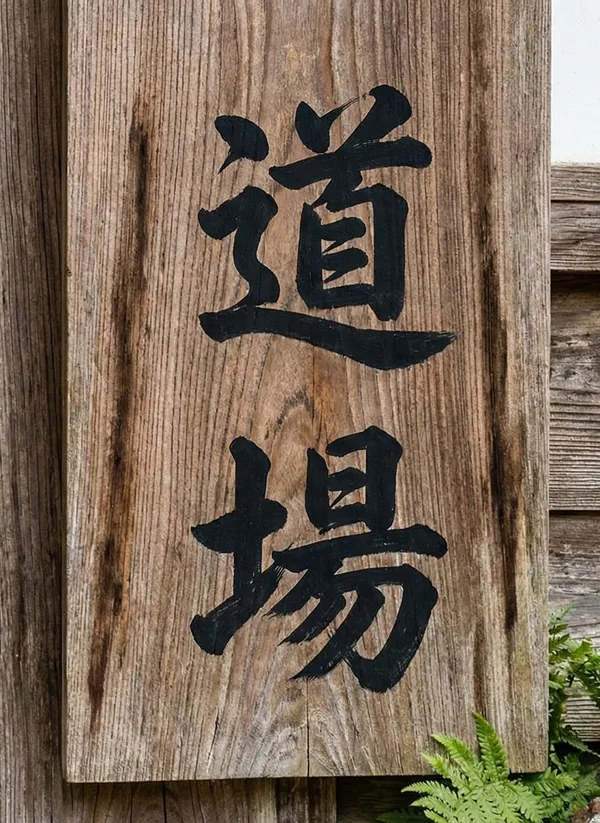
The Battlefield of Enlightenment The historical, architectural, and spiritual background of the Aikido Dojo
-
February 5, 2026 -
Ferenc Németh
Just because you have a place to practice doesn't necessarily mean it is a Dojo.
A Dojo is not merely a gym; it is more than that. It has a special scent, atmosphere, and aura. For me, it is a place where I feel at home, and where I always go with pleasure. Within these walls, one can somehow sense the spirit of those who practice there, and the design of the space reflects the owner's attitude toward martial arts. But what lies behind this difference? What is that invisible structure that turns a gymnasium into a sanctuary?
The purpose of this writing is to uncover the deeper layers of the Dojo institution, from historical roots through sacred architecture to spiritual dynamics.
1. Etymological Archaeology: From the Bodhi Tree to Japan
Understanding the term Dojo (道場) is impossible without a deep examination of its linguistic roots. The layers of meaning within the word carry thousands of years of philosophical development.
1.1 The Legacy of Bodhimanda
The Japanese character combination is a direct translation of the Sanskrit term Bodhimanda. In the original Buddhist context, Bodhi denotes "enlightenment," while Manda means "circle" or "place." Its meaning, therefore, is: „The Place of Enlightenment”.
Historically, this referred to the specific physical point in Bodh Gaya, India, under the Bodhi tree, where Buddha achieved complete enlightenment. In Buddhist cosmology, this is the center of the world (Axis Mundi), the only place stable enough to bear the weight of enlightenment.
1.2 The Japanese Evolution of Terminology
In Japan, the concept (Daochang) initially designated the meditation halls of monasteries. The great turning point came during the peacetime of the samurai (Edo period), when combat techniques (Bujutsu) evolved into martial arts (Budo). Warriors realized that swordsmanship could also be "Zen in motion." In Aikido, this development reached its peak: the Dojo is no longer a training ground for war, but for the "Art of Peace."
2. The Boundary of "Outside" and "Inside": A Psychological Airlock
This historical sacredness manifests in daily practice as well. I almost always feel the contrast between the outside and inside worlds, especially during adult training sessions. With children, the bustle before lining up still resembles the outside world, but with adults, everything changes after the bow.
The warm-up is palpably not just a physical tuning-in, but a spiritual one as well. Preparation in body and soul. Setting off for training is often not easy; workplace troubles pull you back, and many stay away because of this. However, by the end, everything transforms: everyone leaves cheerfully and free of tension. This is one of the most important functions of the Dojo, the Misogi (purification), which I will discuss in detail later.
3. Sacred Architecture and Spatial Arrangement
The layout of a traditional Aikido Dojo is not merely functional but deeply symbolic. Every segment of the space carries a specific meaning.
3.1 The Cosmology of the Four Directions
- Kamiza (上座 - Upper Seat): The most sacred point of the Dojo, usually in the North. Here dwells the Kami (spirit); this is the source of authority and light.
- Shimoza (下座 - Lower Seat): The line of students sits here. This is the place of receptivity, humility, and openness.
- Joseki and Shimoseki: The sides for advanced students and beginners. This arrangement models the flow of knowledge (Nagare): just as water flows from high to low, knowledge flows from the Kamiza toward the Shimoza.
3.2 The Symbolism of the Tatami
Even the layout of the Tatami covering the floor follows strict rules. The corners must never form a cross (+) shape because that evokes funeral rites and is considered "ominous." Instead, the "T" shaped intersection, the Syugi-jiki (auspicious arrangement), is applied, which facilitates the flow of good energy and is safer during falls.
4. The Absence of Mirrors and Inner Vision
It is worth observing a fundamental difference: the walls of modern gyms are full of mirrors so athletes can see their muscles. In traditional Dojos (except for technical correction corners), there are no wall mirrors.
As a beginner, everyone strives and does everything to execute the technique with their partner, sometimes at any cost. It took me about 10 years to realize that this is not possible that way, and I shouldn't feel frustrated because of it. Aikido is a paired practice where success always depends on two people; one is not enough.
The absence of a mirror teaches this: you shouldn't look at the external image. My partner is my mirror. If this understanding is not yet present in the other person, I must let go of the compulsion to conform.
The only mirror in the Dojo is the Kagami (sacred metal disc) found on the Kamidana (altar). However, this does not show the exterior, but the "stripped soul." When we bow before it, we are checking our internal purity.
5. Spiritual Dynamics: "Misogi" and Rituals
5.1 Misogi: The Alchemy of Purification
One of Morihei Ueshiba's most important teachings is: "Aikido is Misogi." This is an ancient Shinto purification ritual, the removal of Kegare (impurity). In the Dojo, Misogi takes place on several levels:
- Physical: Detoxification through intense sweating.
- Mental: Ego-polishing through throws and falls.
- Spatial (Soji): Cleaning the Dojo is not a hygienic compulsion but a spiritual practice. When students wipe the tatami on their knees, they are polishing their own minds as well.
5.2 The Mystery of Clapping (Kashiwade)
One of the most interesting elements of Aikido rituals is the clapping. While in standard Shinto shrines "2 claps" is customary, in some traditional Iwama-style dojos (due to the founder's Omoto-kyo ties), they apply 4 claps. These four claps symbolize the four aspects of the soul (Shikon):
- Courage (Ara-mitama)
- Wisdom (Kushi-mitama)
- Love (Nigi-mitama)
- Friendship (Saki-mitama)
6. Psychological Architecture: The Sounds of Silence
Ultimately, the Dojo is a psychological laboratory where we develop special states of consciousness:
- Shoshin (Beginner's Mind): Maintaining openness even as a black belt.
- Zanshin (Lingering Spirit): Maintaining relaxed alertness even after the technique.
This Zanshin is most beautifully captured in the moments before practice. Most of the time, if I can, I arrive early at the Dojo. At such times, I am still alone; there is complete silence. Sometimes I put on some quiet music that I like to listen to while warming up. Often, I don't even turn on the main lights, just a desk lamp; twilight accompanies the silence, especially in winter and in the morning. In this silence, the focus that later provides the foundation for movements on the tatami is born.
Conclusion
The Dojo is more than wood, brick, and tatami. It is an alchemical crucible where raw human material is ennobled in the fire of discipline. Historically, it evolved from the site of Buddhist enlightenment into a sanctuary of peace.
According to Morihei Ueshiba's teaching: "Heaven is right where you are standing, and that is the place to train." Our task is to take that inner peace we found in the silence of the dim room or in the heat of practice, and carry it with us beyond the gate.