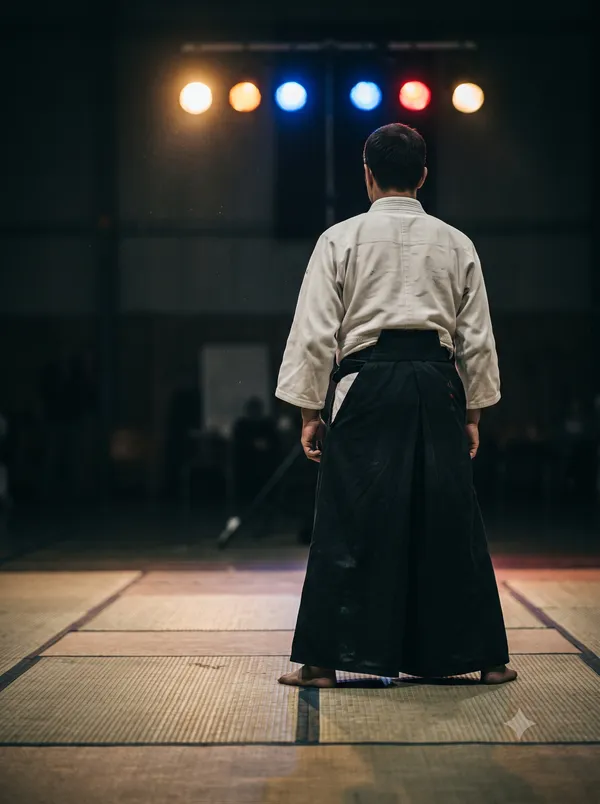
The Illusion of Aikido Demonstrations and the raw reality
-
31 August 2026. -
Ferenc Németh
Early in my career, I honestly believed in the magic of martial arts demonstrations. I should note that back then, the internet and YouTube did not exist, so it was quite rare for this form of movement to appear in public at all. Such an occasion was a true curiosity. I gladly attended and participated in aikido demonstrations because I thought it was the best way to convey the beauty and effectiveness of the system to an audience.
I had a truly defining experience at one such event that I haven't forgotten since. We were holding a demonstration with Csaba Molnár at the Kistarcsa dojo, and I experienced something there that has perhaps happened only once in my roughly twenty-five years of practice. A technique simply just happened to me. I wasn't acting, I wasn't being a "good uke" in the theatrical sense, I just cleanly attacked—and in the next almost imperceptible moment, I was already on the ground.
Today, however, my perspective on demonstrations has completely changed. I increasingly see formal demonstrations as meaningless, because there is an often insurmountable gap between the reality of the tatami and everyday practice. Nowadays, the internet is full of self-proclaimed experts and "perfect" solutions that often only work on screen, and live demonstrations have lost their old magic in a world filled with changed expectations.
The audience thirsts for blood, not clean technique
The modern audience's stimulus threshold is set by today's action movies, MMA, and cage fighting. Let's be honest—the majority of onlookers are mostly interested in brutality, aggression, and "bloody fights."
An aikido technique can be beautifully, meticulously executed and clean, but if there's no blood at the end, it simply fails to achieve the desired effect for laypeople. Clean biomechanics and the control of violence are uneventful to them. Even the most refined, masterful movements seem woefully boring to an eye seeking the drama of cage fights. Half the audience walks away after the first four minutes, or turns their backs and starts chatting, because they aren't getting the raw aggression they expect from a fight today.
Demonstrating as a separate genre
It’s not that it's impossible to hold a brilliant, breathtaking aikido demonstration. Yes, it is possible. The most outstanding examples of this are the performances by masters like Christian Tissier or Bruno Gonzalez. However, it’s important to see that something entirely different is happening behind the scenes for them. In their case, the ukes are carefully selected from among the most advanced students specifically for this task, and they spend a long time preparing dedicatedly just for this.
In my opinion, demonstrating is a completely separate genre. For a demonstration to truly work, a precise knowledge of aikido elements and techniques is simply not enough. You also need a certain theatrical attitude. The spectacular elements must be slightly exaggerated, consciously presented to the audience's eyes, while carefully balancing the proportions so the end result accurately simulates reality. This is an independent, high-level performing art.
The goal: recruitment (which mostly backfires)
Let's ask the most important question: what is the original goal of a demonstration? Basically, to attract people into the dojo. The problem begins with the fact that a technique executed in a closed dojo, even if highly effective, will not be appealing to laypeople. Because its essence—the stable base, the internal tensions, the precise timing—is an invisible internal work. The audience craves a theatrical experience, which is why they always watch the flying uke, as that is what’s spectacular. In reality, it is this hidden, internal work that triggers the fall or the roll. True, the end result, the effect, is visible from the outside, but a lay spectator in the stands almost never notices the root cause. A refined aikido technique is simply not meant for a theatrical audience.
The lack of a screenwriter and endless boredom
In most cases, aikido demonstrations end up being too long and exceptionally boring for the outside observer. There is a very simple reason for this: the master designing the demonstration is a martial artist, not a screenwriter.
When they are on the tatami, regulating the other person with a sword or staff in hand, or executing dynamic rolls, they enjoy it immensely themselves. They are in the flow, feeling the joy of movement, but they forget the most important rule: an outside, untrained spectator understands absolutely nothing of this whole thing. To them, it's just minutes of monotonous repetition.
The dark side of big stages: Illusions at the highest level
Unfortunately, this kind of inauthenticity is not only experienced at smaller dojo demonstrations. Watching footage of the most prestigious international main-stage demonstrations held year after year, one is often struck by a serious sense of deficiency from a professional point of view. Although we are talking about the highest-level events in the genre, it is sometimes hard to understand how certain productions make it in front of such a large audience.
Often, instead of clean biomechanics, we see unjustified roughness and exaggerated, violent finishes. The demonstrator might feel this is dynamic and authoritative, but in reality, it often merely shows the uke's vulnerability as the attacker is practically smeared into the ground at the end.
What is most concerning, however, is that the very essence of martial arts is missing from many of these demonstrations: a real attack and its realistic handling. It’s a common scene that after the uke hits the ground, before they have even regained a stable position, they are already rushing back toward the tori. They merely put their hand out as if to strike, but the movement lacks true intent, focus, and power.
And it's very important to clarify something here: I'm not complaining about why the uke doesn't beat up the tori. I am complaining that there isn't the slightest intent to simulate a real attack. Aikido—if it can work realistically at all—can only be effective if the attacker commits everything to a single strike or attack. Aikido is not for a cat-and-mouse fight. It is not a cage fight where the parties jump around, test, and measure each other for minutes. It is a system built on a clean, committed attack, and if this overwhelming commitment is missing, the demonstration becomes an empty, inauthentic dance that damages aikido's international reputation.
For me, a two-minute demonstration would be much more educational and professional if, say, after a minute of waiting, someone showcased a single, perfectly executed technique. That would be worth a thousand times more than everyone grinding through the usual techniques without any real value or substance.
The classic trap: "Come on, show me something!"
There is also an everyday mutation of theatrical demonstrations that is familiar to every martial artist—but especially to aikidokas. When laypeople or acquaintances find out that you have been practicing this martial art for a long time, the request routinely arrives: "You do aikido? Come on, show me something!"
This situation is almost always doomed to fail; it’s aikido's classic Catch-22. The person asking is completely unequipped to come out of a technique without injury, leaving you with two choices:
- If you are careful: You execute the movement in a way that absolutely doesn't hurt them. The feedback is guaranteed to be condescending: "What was that? I didn't feel anything, aikido has no power." Many people blame the martial art at this point, while you were merely protecting their physical well-being.
- If you do it for real: If you apply clean biomechanics so they feel its effectiveness, it will immediately result in a serious injury because the layperson doesn't know how to fall, doesn't know ukemi, and reacts poorly to joint locks. Then comes the justified outrage: "Why did you just smash me in the mouth and half-break my wrist?!"
A responsible instructor never intentionally causes injury in such a situation. If circumstances make a demonstration unavoidable, the best tactic is careful observation of the situation. During the conversation, I already notice which hand is relatively easy to grab. I position myself slightly to the side, preparing for the grip, then I grab their hand with a grip used for a nikyo or sankyo technique and apply slight pressure. Obviously, this is a very unexpected move, since up to that point in the conversation it seemed I wasn't going to show anything. Such a surprising yet subtle movement signals the power of the system immediately, without injury, and highly convincingly.
What is truly useful? (Interactive experience)
My final conclusion regarding demonstrations today is very simple: I never hold formal demonstrations. If theatrical performances don't work, what can actually be useful for those interested? Instead of passive observation, an open, shared class.
Instead of formal demonstrations, it’s worth much more to invite laypeople onto the tatami and treat the whole thing as a collaborative workshop. Here, you shouldn't lecture people from the pose of an untouchable, all-knowing master whom everyone should fear. It is much more authentic to stand there with the attitude of an approachable, more experienced practice leader. Let the tatami be a place where people can come up, ask questions, and try things out.
After a joint warm-up, we try out a few basic aikido exercises together, step by step. Starting from very simple connection drills, through subtle unbalancing and rolls, all the way to a basic rolling exercise. And for those who are truly adventurous, they can even try falling over a partner within a safe framework.
Aikido is not meant to be watched from the stands, nor should its effectiveness be proven on the street; it must be experienced with our own bodies. When the layperson has to take off their shoes, step onto the mat, and realizes during the workshop that even maintaining their own balance or coordinating their body parts is not an easy thing, their external, judgmental position turns into humility and respect in a matter of moments.